Five Pedals That Shaped the Sound of Rock
Behind some of rock's greatest riffs is a small box on the floor. Here are five types of effects pedal every guitarist should know, and the records that made them famous.
Words by Dave Rourke · 16 November 2026
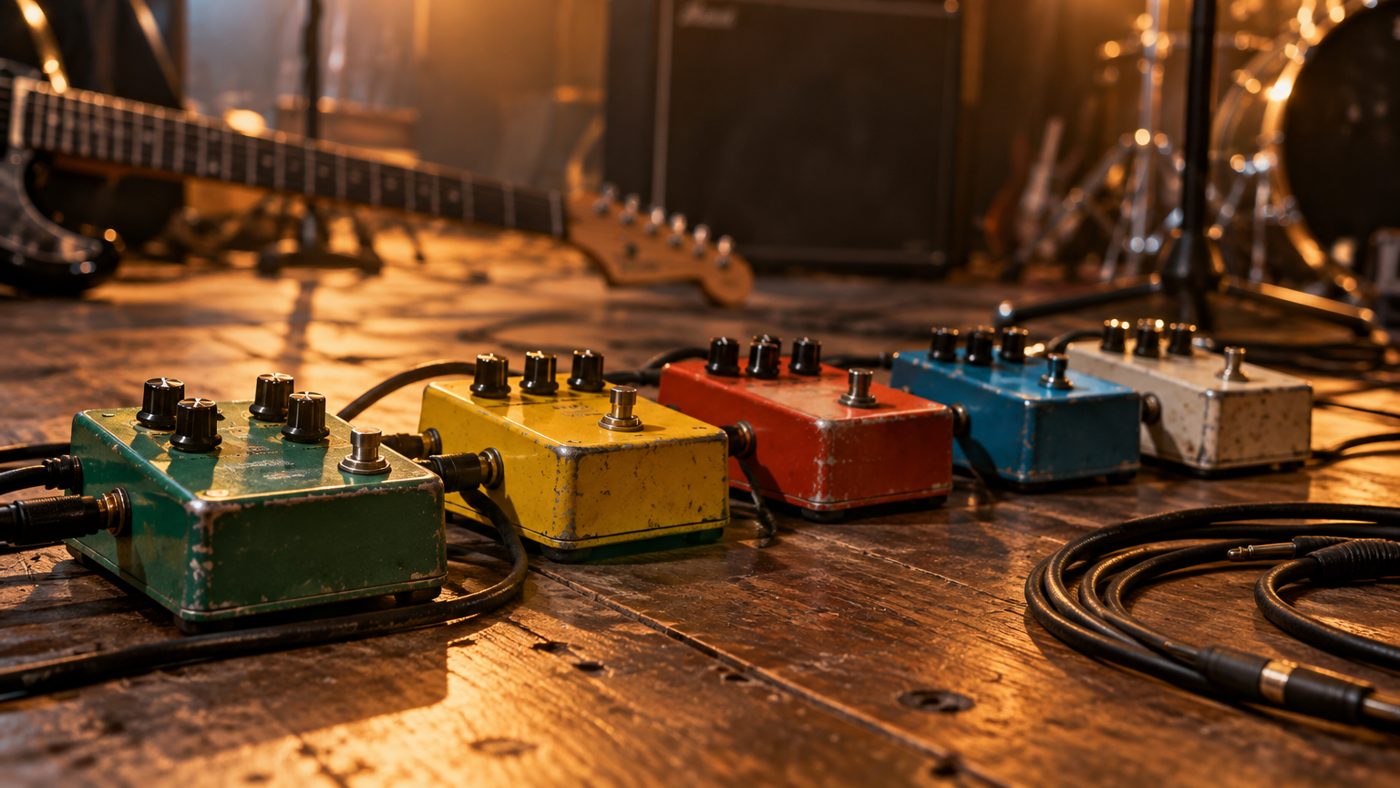
Some of the most famous guitar sounds in history didn't come from the guitar at all. They came from a small metal box on the floor. Here are five types of pedal that changed rock, and why they still matter.
1. The fuzz
The first fuzz pedals arrived in the early 1960s, and in 1965 a fuzz box gave The Rolling Stones' '(I Can't Get No) Satisfaction' its unforgettable riff. Jimi Hendrix later made the fuzz face part of his sound. Thick, buzzing and gloriously rude.
2. The wah
Rock it with your foot and the guitar starts to talk. Hendrix's 'Voodoo Child (Slight Return)' and Cream-era Clapton made the wah a classic, and Slash and Kirk Hammett carried it into the 80s.
3. The overdrive
A small boost that pushes your amp into warm, singing distortion. Overdrive pedals are the backbone of blues-rock and still sit on more pedalboards than almost anything else.
4. The delay
Echo turns a few notes into something huge. The Edge built U2's whole guitar sound on rhythmic delay, and Pink Floyd's David Gilmour used it to make solos that seem to float.
5. The phaser and flanger
That swirling, jet-plane sound. Eddie Van Halen's phaser is all over the first Van Halen album, and flangers gave late-70s and 80s rock its shimmer.
Getting started
- Start with one. An overdrive is the best first pedal for most rock players.
- Buy second-hand. Pedals are tough and hold their value, so used ones are great value.
- Order matters. A common chain is: wah, then fuzz or overdrive, then modulation (phaser or flanger), then delay.
- Play more than you tweak. The best tone is the one you actually make music with.
A pedalboard grows over the years, a bit like a record collection. And like a record collection, every box on it has a story.